Luxury Home Water Damage & Mould Remediation in Ottawa
Discreet water damage and mould remediation for luxury homes and estates in Ottawa, using advanced diagnostics, low-impact containment, careful protection and documented results.
A high-value residence needs more than fast water removal. It needs a discreet, measured remediation plan that protects custom finishes, limits disruption and produces defensible evidence of what was found, treated and verified.
24/7 Remedial Services works with high-end homeowners, estate managers, architects, real-estate professionals and property representatives across Ottawa and Eastern Ontario. Our 24/7 dispatch combines trained personnel, current inspection technology and careful site controls. Most Ottawa emergency calls are attended in under 90 minutes.
If water, mould, smoke or an unexplained odour is affecting your property, call (855) 324-7356 or contact emergency dispatch. We keep the conversation focused, respect privacy and build the scope around the property—not a one-size-fits-all package.
What luxury-property remediation requires
A concealed leak in a custom home may affect imported stone, millwork, radiant-floor assemblies, integrated lighting, acoustic treatments, art storage or complex mechanical systems. The visible stain is rarely the complete loss. A professional response must answer four questions quickly:
- Where did the moisture travel?
- Which assemblies can be preserved safely?
- How can the work zone be isolated without creating avoidable damage or noise?
- What measurements will prove the affected area is dry or decontaminated?
That is why our approach begins with investigation and documentation before intrusive work.
Advanced inspection technology for high-value homes
Thermal imaging and high-resolution moisture measurement
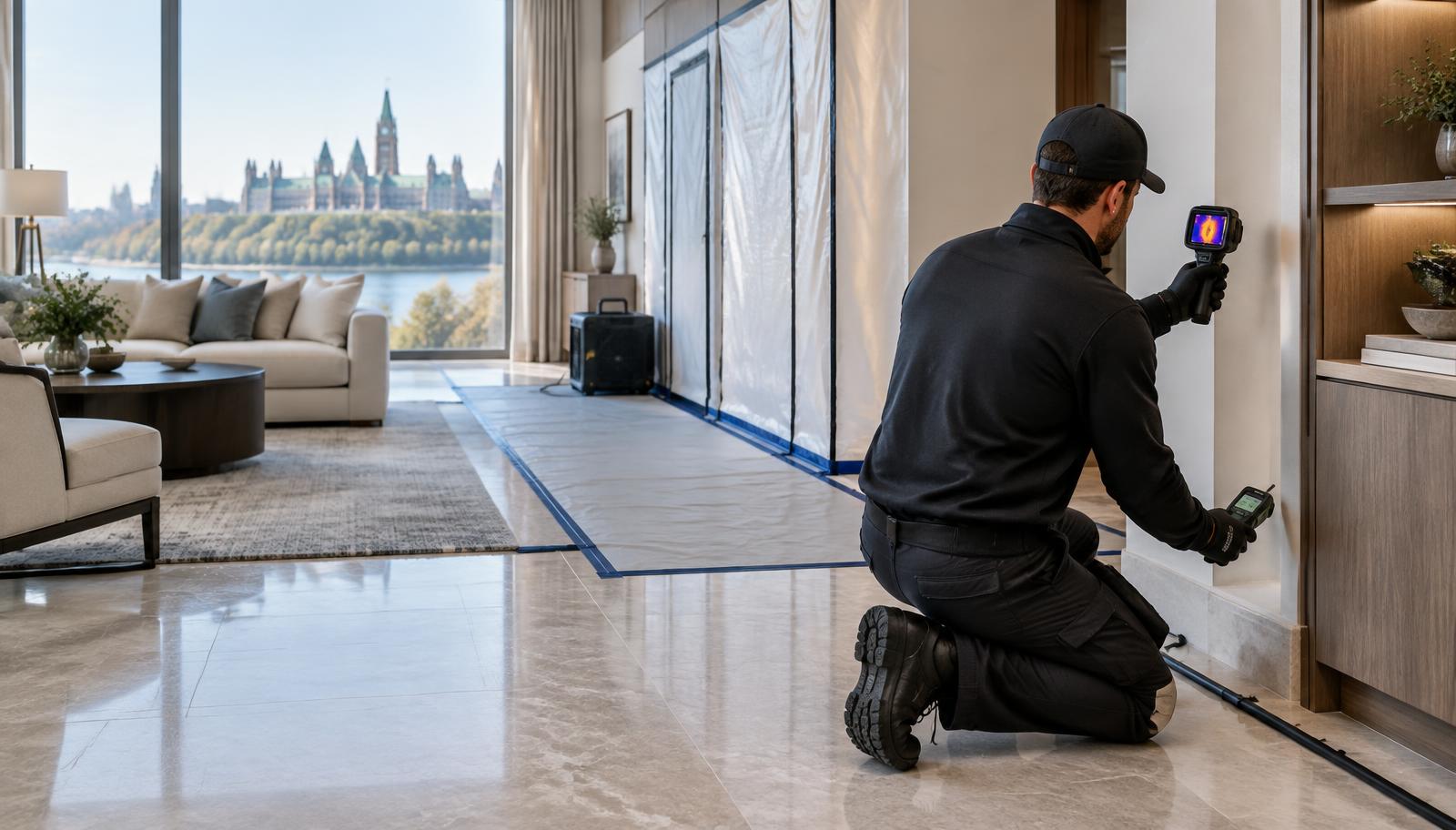
Thermal cameras identify temperature anomalies that can indicate evaporative cooling, wet insulation or hidden water pathways. They do not see through walls and do not prove mould; each anomaly is checked with direct readings. High-end Protimeter moisture instruments help compare suspect materials with dry reference areas and track progress through the drying cycle.
Endoscope inspection with smaller access points
An endoscope can inspect selected concealed cavities through a small, controlled opening. Where conditions allow, this can reduce exploratory disturbance around custom wall finishes, cabinetry and built-ins. It is a diagnostic aid, not a substitute for direct moisture readings or hazardous-material precautions.
Drone-assisted exterior inspection
For large roofs, steep elevations and difficult exterior details, drone imagery can help document roof surfaces, flashing, drainage and possible entry points before physical access. Drone use is subject to weather, site conditions, privacy, airspace rules and safe-operation requirements. Findings that affect the scope are verified by an appropriate hands-on inspection.
AirWall containment and low-impact work zones
Traditional temporary partitions can require fastening into finished surfaces. Where the room and scope permit, reusable AirWall-style modular barriers create a rigid, cleanable separation with less reliance on attachment to finished floors or painted surfaces. They can also create a more orderly work zone and help reduce sound transfer compared with an open work area.
Containment design still depends on the hazard. Mould, sewage or contaminated dust may require sealed polyethylene transitions, HEPA-filtered negative air, pressure monitoring and controlled entry. No barrier makes remediation silent, but thoughtful staging, quiet-work windows and equipment placement can materially reduce disruption.
Protecting finishes, furnishings and privacy
Before equipment or tools move through the property, the crew plans access. Depending on the site, controls may include:
- Non-marking floor protection and clean runner paths
- Corner, threshold and elevator protection
- Dust-controlled access and HEPA filtration
- Segregated equipment staging and disciplined cable management
- Photo documentation limited to the affected area and required evidence
- Scheduling coordinated with occupants, property managers or security personnel
- Need-to-know handling of contact and property information
We do not publish client names, addresses or project details without permission. Sensitive belongings and areas outside the authorized scope remain outside our documentation wherever practical. See our privacy policy.
Water damage: preserve first, remove only when evidence requires it
Fast extraction and controlled structural drying can preserve more of a high-value interior. Our process includes source review, moisture mapping, water-category assessment, extraction, selective access, psychrometric calculations and daily material readings.
Commercial LGR or desiccant dehumidification, focused air movement and HEPA filtration are selected for the actual assembly and conditions. Equipment placement considers airflow, electrical capacity, occupant routes, acoustics and finish protection—not simply the number of machines that fit in a room.
For an Ottawa water emergency, see Ottawa water damage restoration and our guide to structural drying timelines.
Mould: containment, source control and verification
High-end materials do not change the fundamentals of professional mould remediation. The moisture source must be found; the affected boundary must be defined; cross-contamination must be controlled; and completion must be verified.
24/7 Remedial Services is PMII Certified Mold Remediator certified and a NAMRI member. Depending on conditions, a mould scope can include negative-air containment, HEPA air filtration, controlled removal of non-salvageable porous materials, physical HEPA cleaning, structural drying, detailed cleaning and independent post-remediation verification when appropriate.
A coating, fragrance or quick surface treatment is not a substitute for source correction and physical remediation. Read about Ottawa mould remediation, or book a professional mould inspection.
A professional sequence for a discreet remediation project
1. Confidential intake and rapid triage
We identify the emergency, access constraints, vulnerable occupants, valuable finishes, privacy expectations and the decision-maker. Active water, sewage, fire residue and unsafe air conditions receive priority dispatch.
2. Non-invasive assessment first
The technician begins with visual investigation, thermal patterns and direct moisture readings. Endoscopes or drone imagery are used only where they answer a defined question safely and lawfully.
3. Written, room-specific scope
The proposed scope separates salvageable and non-salvageable materials, defines containment and equipment, and identifies tasks that belong to another qualified trade. The client approves the scope before non-emergency work proceeds.
4. Protected setup and controlled remediation
Access routes and finishes are protected, containment is established, and extraction, drying, cleaning, hazardous-material abatement or sanitization proceeds under documented controls.
5. Measurement-based closeout
Work concludes when objective criteria are met—not when equipment has merely run for a fixed number of days. Closeout can include final moisture readings, psychrometric records, photographs, cleaning records and third-party verification where the scope calls for it.
Direct-client service and clear documentation
We are hired by and work for the property owner or authorized representative. The client pays us directly. We provide an itemized scope, photographs, moisture and drying records, and supporting documentation that the client can submit to an insurer for independent reimbursement..
This direct relationship keeps instructions, approvals and priorities aligned with the client. If financing is needed, options are available through financial partners; approval and terms are set by the partner.
Our remediation scope—and where it ends
Our work includes emergency mitigation, water extraction, structural drying, mould remediation, hazardous-material abatement, smoke and odour remediation, sanitization and documentation. We do not rebuild. After the area is dry, decontaminated and documented, the client may engage their own designer or contractor for repairs and decorative finishes.
Frequently asked questions
Do you work with luxury homeowners and private estates in Ottawa?
Yes. We assist high-end homeowners and their authorized representatives with discreet water, mould, smoke and odour remediation. The scope is adapted to valuable finishes, occupancy, access and privacy requirements.
Can thermal imaging find hidden water without opening walls?
It can identify temperature anomalies that guide the inspection, but it cannot confirm water or mould by itself. We verify patterns with calibrated moisture readings and use controlled cavity access only when needed.
Will AirWall containment prevent damage and noise?
Where suitable, modular AirWall-style barriers reduce reliance on fastening into finished surfaces and create a more orderly separation. They may reduce sound transfer, but no remediation system is silent. Hazard-specific containment requirements always take priority.
Do you use drones for property inspections?
Drone imagery may be used for roofs, elevations and hard-to-reach exterior details when weather, privacy, airspace and safe-operation rules allow. Material findings are confirmed by hands-on inspection before a remediation decision.
How do you protect client privacy?
We limit access and documentation to what the project requires, coordinate with the authorized contact, and do not publish identifying project information without permission.
Do you handle the repairs after remediation?
No. We perform mitigation and remediation only. We return the area dry, decontaminated, verified and documented for the client's own contractor to complete repairs.
Ottawa and Eastern Ontario response
Our primary market for premium residential response is Ottawa, including Rockcliffe Park, New Edinburgh, Westboro, the Glebe, Manotick, Kanata, Nepean, Barrhaven and Orléans. We also attend Kingston, Brockville, Cornwall, Belleville and communities across Eastern Ontario. For emergency work outside this corridor, contact dispatch; we do not turn clients away and a coordinator will confirm availability and an arrival window.
Need discreet help now? Call (855) 324-7356 for 24/7 emergency dispatch or request an inspection.
Lire la version française : remédiation pour résidences haut de gamme à Ottawa.
Frequently asked questions
- Do you work with luxury homeowners and private estates in Ottawa?
- Yes. We assist high-end homeowners, estate managers and authorized representatives with discreet water, mould, smoke and odour remediation. The scope is adapted to valuable finishes, occupancy, access and privacy requirements.
- Can thermal imaging find hidden water without opening walls?
- Thermal imaging identifies temperature anomalies that guide an inspection, but it cannot confirm water or mould by itself. We verify patterns with direct moisture readings and use controlled cavity access only when needed.
- How are AirWall barriers used in a finished home?
- Where the room and hazard permit, reusable AirWall-style modular barriers create a rigid, cleanable separation with less reliance on attachment to finished floors or painted surfaces. Hazard-specific containment requirements always take priority.
- Do you use Protimeter instruments, endoscopes and drones?
- Yes. Protimeter moisture instruments support direct material readings; endoscopes can inspect selected cavities through small controlled openings; and drone imagery can document hard-to-reach exterior details when weather, privacy, airspace and safe-operation rules allow.
- How do you protect valuable finishes and client privacy?
- We plan protected access routes, use non-marking floor protection where appropriate, limit photographs to required evidence, coordinate with the authorized contact and never publish identifying project details without permission.
- Do you bill the homeowner's insurer directly?
- No. The client hires and pays us directly. We provide an itemized scope, photographs, moisture and drying records, and supporting documentation the client may submit to their insurer for independent reimbursement.
- Do you rebuild after water or mould remediation?
- No. We provide mitigation and remediation only, including extraction, structural drying, mould treatment, hazardous-material abatement, sanitization and documentation. The client's own contractor handles repairs and decorative finishes.
Service area — Ottawa
Discreet, technology-led water damage and mould remediation for luxury homes and estates in Ottawa and Eastern Ontario.
- Primary city
- Ottawa, ON
- Dispatch
- 24/7/365 — (855) 324-7356
- Sectors covered
- Rockcliffe ParkNew EdinburghWestboroThe GlebeManotickKanataNepeanBarrhavenOrléansKingstonBrockvilleCornwallBelleville
Instant cost estimate
Preliminary CAD range in under a minute. A free on-site inspection confirms the scope, and financing is available while your claim is reviewed.
Estimated mitigation range
$3,978 – $5,850
Mitigation and remediation only — we do not quote or perform reconstruction.
Free instant cost estimators
Get a preliminary CAD range in under a minute — no obligation, no payment details. The on-site visual inspection that confirms it is free, and financing is available if paying up front is a concern.
About this guide & the team behind it
This article was written and reviewed by the PMII-certified restoration technicians at 24/7 Remedial Services, a Kingston, Ontario property-restoration company with more than two decades of combined field and construction experience across Eastern Ontario. We respond 24 hours a day, 7 days a week, 365 days a year to water, fire, smoke, mould, storm, and impact losses across Kingston, Napanee, Brockville, Gananoque, Picton, Belleville, Smiths Falls, Perth, Prescott, Carleton Place, and the surrounding Frontenac, Lennox & Addington, Leeds & Grenville, Lanark, Hastings, and Prince Edward county townships.
Every guide on this blog is grounded in the same industry standards Canadian insurance carriers expect on a properly documented claim file: the IICRC S500 standard for water damage restoration, the IICRC S520 mould standard for professional mould remediation, and industry-standard fire & smoke restoration practices for fire and smoke restoration. Where the article references a Category 1/2/3 water classification, a Class 1–4 drying environment, a Condition 1/2/3 indoor mould assessment, or a specific itemized line item, that terminology is used deliberately — it's the same vocabulary your adjuster uses and the same vocabulary that holds up in subrogation.
If you are dealing with an active loss as you read this, please do not wait. Most Kingston addresses see one of our restoration crews on-site within 60 minutes of dispatch — including overnight, on weekends, and during severe-weather events. Surrounding Eastern Ontario communities follow as quickly as travel allows. The cost of waiting on mitigation is almost always higher than the cost of acting immediately.
How our crews work
- › 24/7/365 dispatch from a Kingston base
- › Free written itemized insurance scope before any work begins
- › Daily timestamped moisture logs & photo documentation
- › Fully itemized documentation accepted by every major Canadian insurer
- › Emergency mitigation start to finish under one accountable project lead
What we restore
- › Water damage — burst pipes, floods, sewage backups
- › Fire & smoke — soot removal, deodourization, structural drying
- › Mould — IICRC S520 containment & clearance
- › Storm & impact — emergency board-up and tarping
- › Commercial, multi-unit, institutional & residential
Need restoration help right now?
24/7 Remedial Services dispatches PMII-certified crews around the clock across Kingston and Eastern Ontario. Whether the damage is water, fire, smoke, mould, or storm-related, calling early in the first 24 hours dramatically reduces the eventual scope of work, the disruption to your property, and the size of your insurance claim. Our team handles the mitigation and the documentation — so you only deal with one accountable contact from the first call through final verification, and you submit our itemized reporting to your insurer for your own reimbursement.