Toronto Flood 2026: What To Do About a Flooded Basement in the First 48 Hours
The September 2, 2026 storm flooded basements across Toronto and the GTA. Here is exactly what to do in the first 48 hours — safety, water category, documentation, drying, and how to reach 24/7 emergency dispatch.
If you have standing water in your basement right now, call 24/7 emergency dispatch at (855) 324-7356. A live coordinator answers every call, 24/7/365, and crews are dispatching across Toronto and the GTA following the September 2 storm.
On the evening of September 2, 2026, severe thunderstorms with destructive winds, hail and extreme rainfall hit Toronto. An emergency alert went out at 5:30 p.m., the Don Valley Parkway closed under water, tens of thousands of customers lost power, and the city woke up on September 3 to what news outlets described as recovery from a "100-year storm". Thousands of basements took on water in a single evening.
Demand for remediation crews after an event like this outruns supply within hours. Many companies are already booking two weeks out. We dispatch 24/7/365, and our scope stops at mitigation — emergency extraction, structural drying, hazardous-material abatement and sanitization. We do not rebuild. That focus is exactly why we can move while general contractors are still quoting.
The 48-hour rule, in plain terms
Mould begins to colonise wet organic material in roughly 24 to 48 hours. Clean water degrades into contaminated water over about the same window. Everything below is ordered by how much damage it prevents per minute spent.
Step 1 — Do not enter a flooded basement with power on
If water has reached outlets, the furnace, the hot water tank, the electrical panel or any plugged-in cord, stay off the stairs. Cut the main breaker only if the panel is reachable from a dry position. If it is not, call Toronto Hydro at 416-542-8000 to cut service at the meter. If you smell gas, leave the building, leave the door open and call Enbridge from outside at 1-866-763-5427.
Step 2 — Stop the source
- Storm or overland water: the source is outside. Do not run sump pumps into a flooded municipal system, and keep people and pets out of the water.
- Sewer backup: stop using every fixture in the house. Each flush adds volume.
- Burst supply line: close the main shut-off, then open a low faucet to relieve the pressure still in the line.
Step 3 — Identify the water category before you touch anything
The IICRC S500 standard defines three categories, and the category decides what can be saved.
| Category | Typical storm-flood source | Consequence |
|---|---|---|
| Category 1 — clean | Burst supply line, water heater | Salvageable with fast extraction and drying; degrades to Category 2 in about 48 hours |
| Category 2 — grey | Failed sump pump, appliance discharge, roof-driven water | Contaminated; underlay and porous materials usually removed |
| Category 3 — black | Sewer backup, overland flood water, river or storm-sewer surcharge | Heavily contaminated; full removal of porous materials under containment |
Most basements flooded by the September 2 storm are Category 3. Overland flood water and sewer surcharge carry pathogens, hydrocarbons and lawn chemicals. Wet-vacuuming it yourself and running a box fan spreads contamination through the return-air system rather than removing it.
Step 4 — Document before you move anything
Ten minutes of photos protects your entire claim.
- Video the whole basement in one continuous pass before anything is moved.
- Photograph the water line on every wall.
- Photograph the failure point — sump, floor drain, window well, cracked line.
- Photograph every damaged item with make, model and serial number.
- Keep a written inventory. Discard nothing until it is documented.
Our full method: how to document water damage for insurance claims.
We work for you, not for your insurance company. Clients pay us directly for mitigation work, and you receive fully itemized professional documentation — moisture logs, thermal images, a defensible written scope, and an Xactimate-format breakdown on request — which you submit to your carrier for your own independent reimbursement..
Step 5 — Do not try to dry it with fans and heat
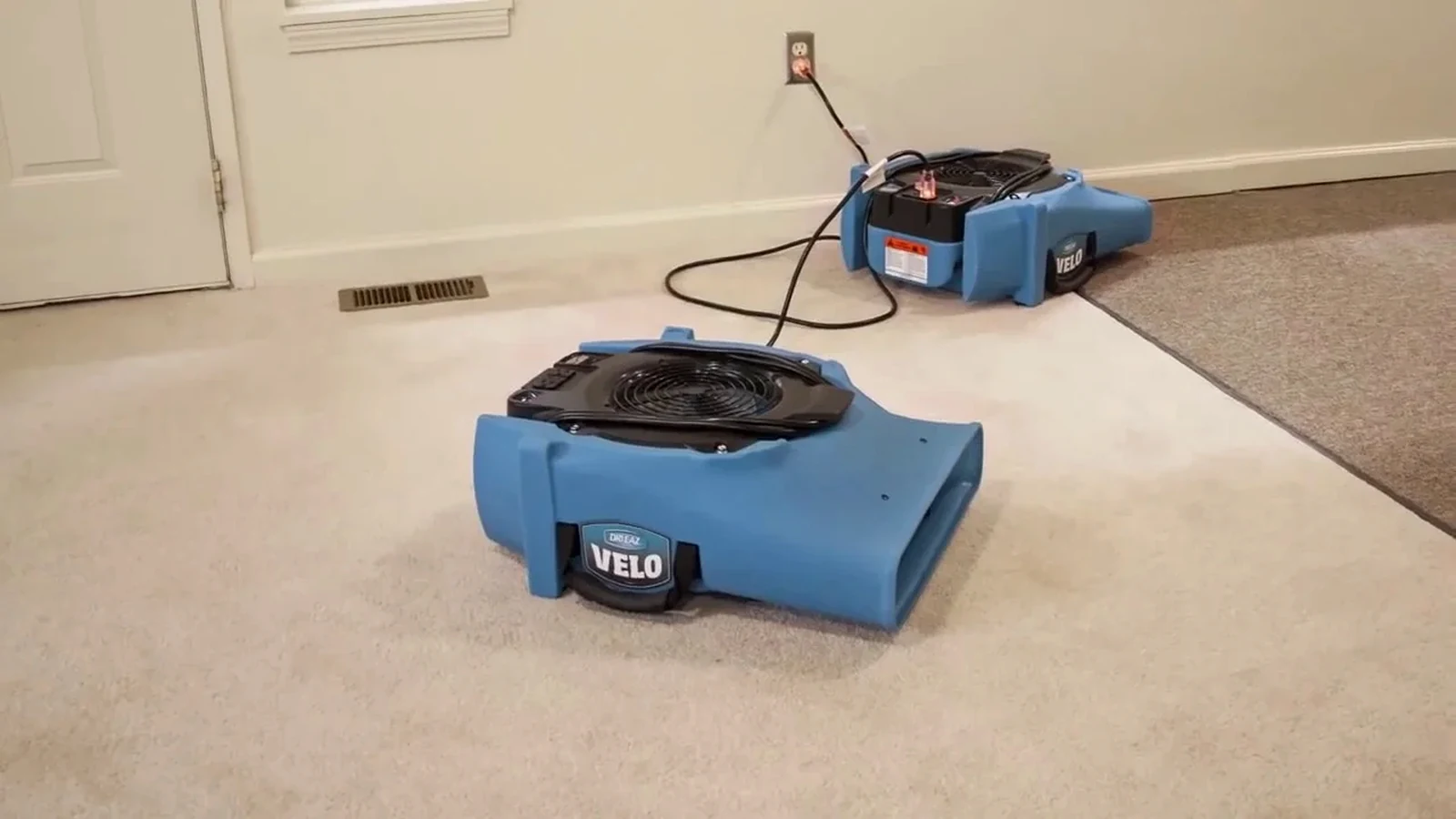
The most expensive mistake after a flood is turning up the furnace and pointing household fans at wet material. Heat drives moisture vapour into cold cavities and the building envelope, where it condenses inside walls and seeds mould you will not see for two months. Structural drying requires controlled dehumidification with daily psychrometric logging — LGR or desiccant equipment sized to the cubic volume of the space, not air movement alone.
What professional drying looks like:
- Moisture mapping with thermal imaging plus pin and pinless meters, because the wet area is almost always larger than the visible one
- Truck-mounted extraction before any drying equipment is set
- Flood cuts to remove non-salvageable porous materials and saturated insulation below the water line
- Negative-air containment with HEPA filtration on any Category 3 loss
- Daily readings — temperature, relative humidity, grains per pound and material moisture content — logged until drying standards are met, typically 3 to 7 days
- Antimicrobial application during the drying window
More detail on our water damage restoration page, and how long it takes to dry a house after flooding.
Mould is the second loss, and it starts this week
Mould needs moisture, an organic food source and a temperature above roughly 4 °C. A September basement in Toronto supplies all three. Watch weekly for:
- A musty or earthy smell, strongest near the floor or in a closed room
- Cupping, lifting or buckling laminate and engineered flooring
- Soft, chalky or stained wall materials within 300 mm of the floor
- Rusted screw heads or staining on the rim joist
- New condensation on the inside of basement windows
See mould remediation and our early mould detection guide. If you already suspect growth, run the free mould estimator for an instant range.
What it costs
Use the free water damage estimator for an instant range with no payment and no contact details required. Typical mitigation-only bands:
- Small Category 1 loss, one room dried in place: $1,800–$3,500 CAD
- Typical basement loss: $3,500–$7,500
- Large or Category 3 sewage event: $7,500–$18,000+
Those figures cover mitigation, drying, abatement and sanitization only. Rebuilding is handled by your own contractor after the structure passes drying verification. If the numbers are difficult, financing is available through our financial partners, including for clients with lower credit scores — ask your coordinator.
Insurance after the September 2026 Ontario storm
Sudden and accidental water damage from internal plumbing is covered under most standard Ontario policies. Overland flood and sewer backup require specific endorsements — the two coverages that decide most storm claims. Notify your carrier early, keep every receipt, and keep the documentation package we produce. The Insurance Bureau of Canada confirms water damage is the largest single category of Canadian home insurance claims.
Frequently asked questions
How fast can you get to my flooded Toronto basement?
Dispatch is live 24/7/365 and crews are actively working the post-storm surge across Toronto and the GTA. Call (855) 324-7356 and a coordinator will give you a real arrival window for your address rather than a two-week booking.
Is storm flood water in my basement dangerous?
Treat it as Category 3. Overland flood water and sewer surcharge carry pathogens and chemical contaminants. Keep people and pets out, do not wet-vacuum it, and do not run the furnace fan while the area is wet.
Can I clean up a flooded basement myself?
You can safely photograph, shut off the source and move dry contents upstairs. Extraction, removal of contaminated porous materials and structural drying of a Category 3 loss need containment, HEPA filtration and metered drying to be done without spreading contamination.
Do you bill my insurance company?
No. Clients pay us directly for mitigation work. You receive fully itemized documentation — moisture logs, photos, a defensible written scope and an Xactimate-format breakdown on request — that you submit to your insurer yourself.
How long does drying take after a flood?
Most basements reach drying standards in three to seven days with correctly sized equipment and daily monitoring. Losses left wet beyond 48 hours often shift from drying into mould remediation, which takes longer and costs more.
Do you do the rebuild too?
No. Our scope stops at mitigation, extraction, structural drying, hazardous-material abatement and sanitization. We do not rebuild. We hand you verified dry readings and a documented scope so your own contractor can start immediately.
What should I do first, right now?
Cut power if water is near anything electrical, stop the source, photograph everything, keep people out of the water, and call (855) 324-7356 for 24/7 emergency dispatch.
Related Services
If this loss is more extensive than a single-room cleanup, these services are the next step:
- Water damage restoration — Emergency extraction, structural drying, and daily moisture monitoring for flooded basements and water losses of any category.
- Mould remediation — Containment, HEPA filtration, and removal of colonised porous materials when mould follows a flood.
- Emergency water extraction — 24/7 truck-mounted extraction and initial stabilization for active flooding.
All three are mitigation-only services. We do not rebuild; we hand off verified dry readings and documentation so your own contractor can start immediately.
Get a crew moving
Call (855) 324-7356 for immediate 24/7 dispatch, use the callback form on this page, or contact us here. If it is not an emergency, book an appointment and a coordinator will attend your property.
Frequently asked questions
- Do I need mould testing before remediation in Toronto?
- Not always. Visible growth with an identified moisture source can move straight to remediation. Testing is worth it when the source is unknown, when occupants have symptoms without visible growth, or when a real-estate transaction or landlord dispute needs documented verification.
- Can I remove mould myself with bleach?
- Bleach lightens the surface stain but does not reach hyphae inside porous materials such as wall materials, insulation, or framing, and it does nothing about the moisture that caused the growth. Proper remediation means containment, negative air, removal of affected porous material, HEPA cleaning, and fixing the water source.
- What health effects can indoor mould cause?
- Common reported effects include nasal and sinus irritation, coughing, wheezing, worsened asthma, headaches, and skin or eye irritation. Infants, older adults, and immunocompromised or asthmatic occupants are affected most. Health Canada recommends removing indoor mould growth regardless of species.
- How fast can you get to a property in Toronto?
- Yes. Toronto is inside our standard dispatch radius, and crews are available 24/7/365. Emergency calls are triaged the moment they come in and a crew is assigned with an on-site window confirmed on that first call — mitigation starts the same visit wherever access allows.
- Will you deal with my insurance company?
- We work for you, not for your insurance company. We provide fully itemized documentation — photo and moisture logs, scope of work, and an Xactimate-format breakdown on request — that you submit to your insurance carrier for your own independent reimbursement; the scope answers to your property and your priorities.
- What certifications does your team hold?
- We are IICRC WRT and FSRT certified, PMII Certified Mold Remediator (CMR), and NAMRI members, subrogation certified for claim documentation and recovery support, and qualified for Type 1 and Type 2 asbestos abatement under Ontario Regulation 278/05. The company brings 20+ years of remediation, construction, and structural experience.
Instant cost estimate
Preliminary CAD range in under a minute. A free on-site inspection confirms the scope, and financing is available while your claim is reviewed.
Estimated mitigation range
$2,848 – $4,188
Mitigation and remediation only — we do not quote or perform reconstruction.
Free instant cost estimators
Get a preliminary CAD range in under a minute — no obligation, no payment details. The on-site visual inspection that confirms it is free, and financing is available if paying up front is a concern.
About this guide & the team behind it
This article was written and reviewed by the PMII-certified restoration technicians at 24/7 Remedial Services, a Kingston, Ontario property-restoration company with more than two decades of combined field and construction experience across Eastern Ontario. We respond 24 hours a day, 7 days a week, 365 days a year to water, fire, smoke, mould, storm, and impact losses across Kingston, Napanee, Brockville, Gananoque, Picton, Belleville, Smiths Falls, Perth, Prescott, Carleton Place, and the surrounding Frontenac, Lennox & Addington, Leeds & Grenville, Lanark, Hastings, and Prince Edward county townships.
Every guide on this blog is grounded in the same industry standards Canadian insurance carriers expect on a properly documented claim file: the IICRC S500 standard for water damage restoration, the IICRC S520 mould standard for professional mould remediation, and industry-standard fire & smoke restoration practices for fire and smoke restoration. Where the article references a Category 1/2/3 water classification, a Class 1–4 drying environment, a Condition 1/2/3 indoor mould assessment, or a specific itemized line item, that terminology is used deliberately — it's the same vocabulary your adjuster uses and the same vocabulary that holds up in subrogation.
If you are dealing with an active loss as you read this, please do not wait. Most Kingston addresses see one of our restoration crews on-site within 60 minutes of dispatch — including overnight, on weekends, and during severe-weather events. Surrounding Eastern Ontario communities follow as quickly as travel allows. The cost of waiting on mitigation is almost always higher than the cost of acting immediately.
How our crews work
- › 24/7/365 dispatch from a Kingston base
- › Free written itemized insurance scope before any work begins
- › Daily timestamped moisture logs & photo documentation
- › Fully itemized documentation accepted by every major Canadian insurer
- › Emergency mitigation start to finish under one accountable project lead
What we restore
- › Water damage — burst pipes, floods, sewage backups
- › Fire & smoke — soot removal, deodourization, structural drying
- › Mould — IICRC S520 containment & clearance
- › Storm & impact — emergency board-up and tarping
- › Commercial, multi-unit, institutional & residential
Need restoration help right now?
24/7 Remedial Services dispatches PMII-certified crews around the clock across Kingston and Eastern Ontario. Whether the damage is water, fire, smoke, mould, or storm-related, calling early in the first 24 hours dramatically reduces the eventual scope of work, the disruption to your property, and the size of your insurance claim. Our team handles the mitigation and the documentation — so you only deal with one accountable contact from the first call through final verification, and you submit our itemized reporting to your insurer for your own reimbursement.