
Creosote-Treated Basement Beams: When Removal Isn't an Option, Here's How We Encapsulate and Neutralize Them in Ottawa & Eastern Ontario
Creosote-soaked railway ties and old pressure-treated posts were installed as basement support beams in thousands of Ottawa, Kingston, Carleton Place, Belleville and Eastern Ontario homes from the 1930s through the 1980s. When structural constraints make removal impossible, IICRC WRT/FSRT and PMII CMR-certified encapsulation is the only defensible way to neutralize the phenolic outgassing, PAH exposure, and inspection-report red flags. Here is the full protocol we run on-site.
Dedicated service page: see creosote beam encapsulation for the full scope, pricing bands, and coverage map, or jump straight to the fast-response form and downloadable checklist below.
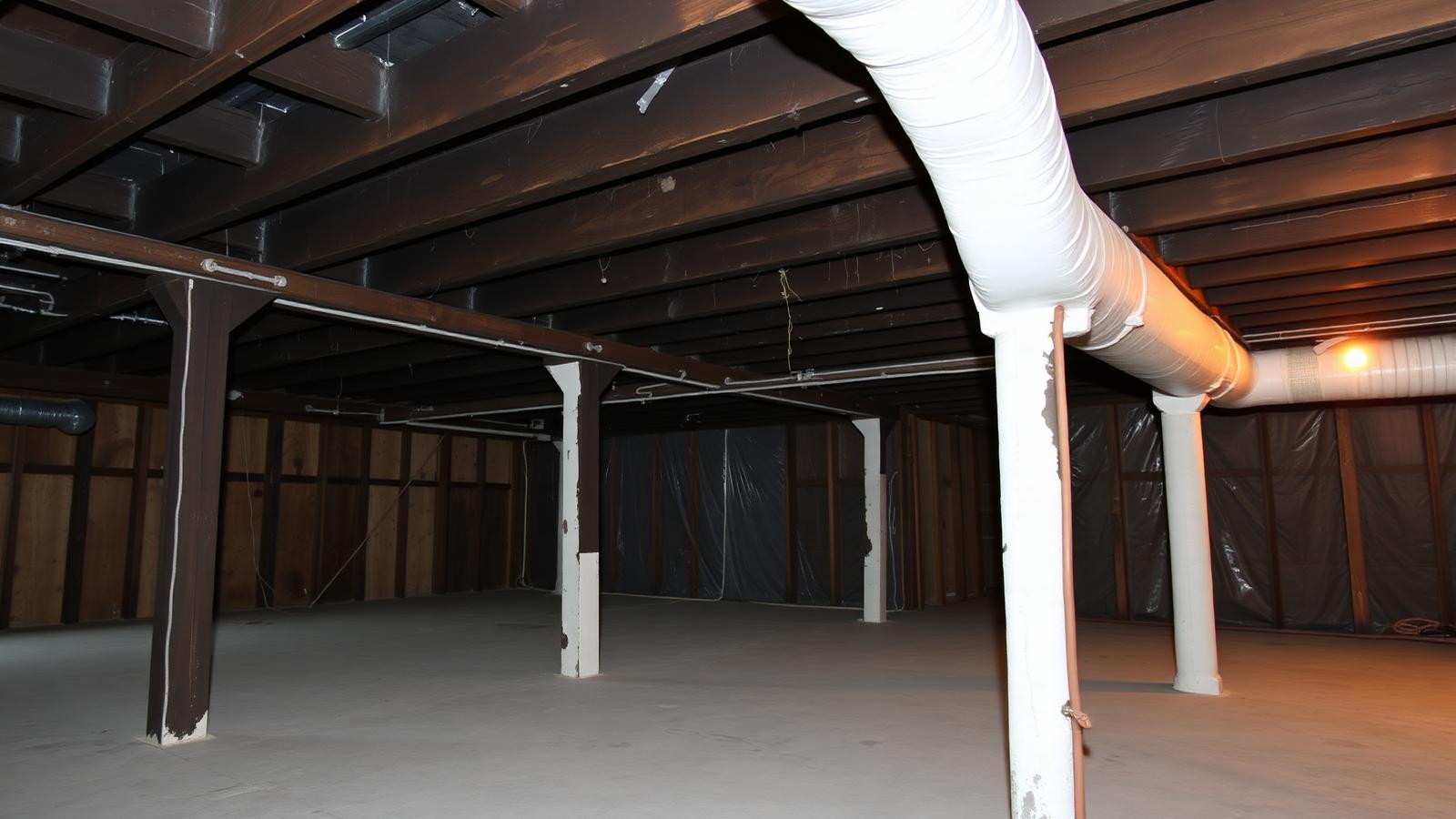
Walk into an older basement in the Glebe, Sandy Hill, Alta Vista, downtown Kingston, Brockville's north end, Belleville's east hill, or any rural farmhouse across Lanark, Leeds & Grenville, or Hastings County, and there is a fair chance you'll catch the same distinctive smell: a sharp, tar-like, faintly medicinal odor that gets stronger on humid summer days and after a basement warms up in early fall. That smell is almost always creosote, outgassing from a support beam, a post, a floor girder, or an old sill plate that was cut from a decommissioned railway tie or pressure-treated with coal-tar creosote decades ago.
For thousands of Eastern Ontario homes, those beams are structural. They are carrying the floor above, they are notched into masonry pockets, they are bolted to lally columns, and they cannot be pulled out without a full structural intervention. When removal isn't an option, encapsulation is. Done right, it eliminates the odor, blocks the polycyclic aromatic hydrocarbon (PAH) outgassing, and closes the inspection-report red flag that has been killing your sale, your rental listing, or your family's quality of life in the basement family room.
This is the exact protocol our IICRC WRT/FSRT and PMII CMR-certified crews at 24/7 Remedial Services execute on creosote encapsulation jobs across Ottawa, Kanata, Nepean, Barrhaven, Orleans, Gloucester, Stittsville, Manotick, Carleton Place, Almonte, Smiths Falls, Perth, Kingston, Napanee, Brockville, Gananoque, Prescott, Belleville, Trenton, Picton, Bowmanville, Oshawa, and Port Hope. Two decades of remediation, construction, and structural-work experience — including senior leadership on some of the country's most complex projects — sit behind every scope.
Active odor issue, closing this week, or a home inspector just flagged a creosote beam? Dispatch a crew: (855) 3247-FLOOD. Ottawa and NCR jobs typically see a certified technician on-site inside 60–90 minutes for the scoping visit, and standard encapsulation turnarounds run 48–72 hours.
Why creosote is still a problem in 2026
Coal-tar creosote was the dominant wood preservative in Canada from the late 1800s through the 1980s. It was cheap, it worked, and it was used everywhere — railway ties, telephone poles, marine pilings, agricultural fence posts, barn timbers, and, critically, support beams, floor girders, sill plates, and cellar posts in residential construction. In Eastern Ontario, decommissioned CN and CP railway ties were routinely repurposed into farmhouses, cottages, and post-war urban infill homes. Many were installed by the previous two owners of the property you live in today.
Health Canada has now classified creosote-treated wood as a restricted-use product. Under PMRA (Pest Management Regulatory Agency) rules, creosote-treated wood is no longer permitted in residential construction, and the U.S. EPA classifies creosote as a probable human carcinogen (Group B1) based on PAH content — naphthalene, benzo[a]pyrene, phenol, cresols, and related aromatic compounds. The problem is that the wood already installed keeps outgassing for 50 to 100+ years, especially when it warms up, humidifies, or gets any air movement across it.
If your basement smells like a railway yard on a warm day, the beam is telling you something is off-gassing into your family's breathing air.
Removal vs. encapsulation — how we decide on-site
Our first step is always to answer one question: can this beam come out? Removal is the ideal outcome — the contaminant leaves the property in a manifested waste stream and never comes back. But removal is rarely possible without a full structural intervention. On the scoping visit, we assess:
- Load path — is this a primary carrying beam, a girder, a post, or a decorative element?
- Connections — is it notched into masonry pockets, welded to a lally column, or bolted into steel?
- Access — can the beam be exposed and removed without demolishing finished ceilings, HVAC, plumbing, or electrical above?
- Cost of substitution — is temporary shoring plus a new LVL, glulam, or steel beam realistic for this property?
- Client goals — closing in 10 days, long-term family home, or income property?
When removal is not on the table — which is most of the time in older Ottawa, Kingston, and Belleville homes — encapsulation is the defensible, PMII-aligned solution. Encapsulation does not mean painting over the problem. Done to the standard below, it chemically isolates the substrate, physically blocks PAH and phenolic vapor migration, and delivers a Post-Remediation Verification (PRV) letter with third-party air sampling that stands up to insurer, lender, and home-inspector scrutiny.
The 5-step creosote encapsulation protocol
This is the exact sequence our crews run on-site. It is the same protocol used in our Environmental Staging playbook and it is the reason our creosote scopes close deals that were about to die on a home-inspection contingency.
Step 1 — Site assessment and pre-remediation baseline
- Full visual and thermographic inspection of the beam, adjacent framing, sill plate, subfloor, and any adjacent joists that may have been treated in the same batch.
- Pre-remediation air sampling for TVOC (total volatile organic compounds), phenol, formaldehyde, and where scoped, PAH-specific analysis, with an unaffected reference area as control.
- Photographic baseline of every beam face, every connection, and every square foot of substrate to be encapsulated.
- Written scope of work with product SKUs, containment specifications, and a fixed 48–72 hour turnaround for standard single-beam jobs.
Step 2 — Negative-pressure containment
Creosote encapsulation is a contained scope of work. Not an optional one — a required one. Airborne PAHs and solvent-carrying primers cannot be permitted to migrate into the rest of the home. Standard containment:
- 6-mil polyethylene walls with zippered decontamination airlock.
- Floor and ceiling seal at every penetration.
- AlorAir CleanShield HEPA 550 (or equivalent) air scrubber with a single-use activated carbon stage filter — the carbon is what adsorbs the phenolic and PAH vapor at source.
- Minimum -5 Pa differential pressure logged on a Testo 510i micromanometer for the duration of the work.
- Ducted external exhaust to prevent any cross-contamination into upper living spaces or the HVAC return.
Critical safety note: every pilot light and gas appliance inside or adjacent to the containment must be shut off before Zinsser B-I-N shellac primer is applied. Shellac carries an ethanol solvent that is flammable during cure. Furnace, water heater, gas fireplace, dryer — all off, tagged, and locked out.
Step 3 — Substrate mechanical prep
- Manual wire-brushing of crystalline chemical efflorescence — the whitish or yellowish crystals that appear on aged creosote beams — from every beam face and end grain.
- Localized solvent wiping with odorless mineral spirits to knock down raw tar gloss where the surface is still tacky.
- No aggressive solvents. Aromatic solvents (xylene, toluene, MEK) mobilize the creosote and leave a lingering vapor footprint that defeats the entire scope. Odorless mineral spirits only.
- HEPA vacuum recovery of all particulate immediately after wire-brushing. Nothing gets swept.
Step 4 — Dual-coat vapor encapsulation
The encapsulant matters. We use Zinsser B-I-N white pigmented shellac primer as the vapor-blocking coat because it is the industry standard for chemically isolating creosote, nicotine, and heavy-tar residues on wood substrates. Applied correctly:
- 360-degree coverage — every beam face, every corner, every notch, every connector plate, every fastener head. The failure mode is always a missed inch.
- Full end-grain coverage. End grain is where the majority of the outgassing happens; if you miss the end grain, you have not encapsulated the beam.
- Two coats minimum, with a 45-minute recoat window at 18–22 °C ambient.
- On heavily saturated beams — think 100-year-old cottage sill plates soaked black with creosote — a third coat and a topcoat of Zinsser Bulls Eye 1-2-3 or an odor-blocking latex primer is added to lock the shellac layer.
Optional: for high-visibility environments (a finished basement family room, a rental unit, a listed property staging), a decorative topcoat matched to the room's finish palette can be applied over the encapsulated substrate once cured.
Step 5 — Demobilization, disposal, and post-remediation verification
- Commercial extraction and hazardous-waste containment of saturated carbon media, wire brushes, solvent-soiled rags, and all single-use PPE.
- Manifested disposal through a licensed Ontario hazardous-waste stream — never a residential curbside bin.
- Post-remediation air sampling (TVOC, formaldehyde, phenol) with a third-party accredited lab, compared against the pre-remediation baseline and the reference area.
- PRV letter delivered to the property owner, listing agent, closing lawyer, and (where applicable) the insurer within 24 hours of demobilization, on 24/7 Remedial Services letterhead, signed by a PMII Certified Mold Remediator.
- Full itemized documentation (Xactimate-format breakdown on request) for any covered scope, insurer subrogation, or seller-credit reconciliation.
Real-world scenarios we see across Eastern Ontario
Scenario 1 — Century home in the Glebe, closing in 10 days
A home inspector notes "strong phenolic odor detected in basement, likely creosote-treated support beam, recommend further evaluation before closing." The buyer's lawyer freezes the deal. The seller has 10 days. Our 48-hour Environmental Staging scope with creosote encapsulation lands a PRV letter on the buyer's file, the financing releases, and the deal closes on schedule.
Scenario 2 — 1960s bungalow in Belleville, family with a newborn
A new parent notices the basement smells stronger at night. Two creosote posts and one girder are identified. Full containment, dual-coat B-I-N encapsulation, and post-remediation air sampling confirm TVOC has dropped from 1,240 μg/m³ to 210 μg/m³ — inside the Health Canada residential guideline. The family reclaims the basement rec room.
Scenario 3 — Rural farmhouse near Perth, sill plate exposure
Entire perimeter sill plate is a repurposed railway tie. Removal would require lifting the house. Full-perimeter encapsulation over four days, with a modified negative-pressure zone rotating around the crawlspace footprint. Deal saved on a $780,000 rural listing.
Scenario 4 — Kingston limestone heritage home
Two primary girders in a stone-walled basement, notched into original masonry pockets. Removal impossible without engineered temporary shoring and municipal heritage-committee sign-off. Encapsulation completed in a single 72-hour mobilization with full documentation for the buyer's home inspector and the seller's insurer.
What creosote encapsulation does not fix
Be honest with yourself before you write a cheque. Encapsulation is a chemistry solution to an outgassing problem. It does not fix:
- Active structural failure. If the beam is rotted, split, deflecting, or losing load capacity, encapsulation is not the scope — structural replacement is.
- Mold on adjacent framing. If the beam has been chronically wet and the joists or subfloor are mold-affected, encapsulation is one line item inside a larger mould remediation scope or basement flood recovery.
- Underlying moisture. If the basement is chronically damp, the encapsulant will hold, but you will have a mold problem around the beam within 12 months. Water management first.
- Category 3 contamination. If sewage or overland floodwater has soaked into the beam, encapsulation is not defensible — the beam is a Cat 3 material and must be removed regardless of structural cost.
Coverage and response windows
- Ottawa core (Centretown, Glebe, Westboro, Alta Vista, Sandy Hill): on-site scoping within 60–90 minutes.
- Kanata, Nepean, Barrhaven, Orleans, Gloucester, Stittsville, Manotick: on-site within 90 minutes.
- Carleton Place, Almonte, Smiths Falls, Perth, Lanark County: 2–3 hours.
- Kingston, Napanee, Odessa, Bath, Amherstview: 60–120 minutes.
- Brockville, Prescott, Gananoque, Leeds & Grenville: 90–120 minutes.
- Belleville, Trenton, Quinte West, Picton, Prince Edward County: 90–150 minutes.
- Bowmanville, Oshawa, Port Hope: 90–150 minutes.
Standard single-beam encapsulation turnaround: 48–72 hours from dispatch to PRV letter, subject to gas shutoff and cure windows communicated at the site visit.
Frequently asked questions
Can creosote beams be safely left in a finished basement?
Only if they have been properly encapsulated to a documented protocol, with post-remediation air sampling confirming TVOC and phenol are within Health Canada residential guidelines. An untreated, off-gassing creosote beam in a finished basement is a chronic indoor-air-quality exposure and a real-estate transaction risk.
Will simply painting a creosote beam solve the odor?
No. Standard latex or oil-based paint is not a vapor barrier and will not block phenolic or PAH outgassing. The creosote will bleed through the coating within weeks. Encapsulation requires a shellac-based primer like Zinsser B-I-N applied in two full coats, 360-degree coverage, with full end-grain treatment.
How long does creosote encapsulation last?
A correctly executed dual-coat Zinsser B-I-N encapsulation typically holds for 15–25+ years on interior, dry substrates. It can be inspected visually every few years and touched up locally if any coating damage occurs from renovations, plumbing work, or HVAC modifications.
Is creosote a carcinogen?
The U.S. EPA classifies coal-tar creosote as a probable human carcinogen (Group B1) based on its PAH content. Health Canada restricts creosote-treated wood to specific industrial uses and prohibits its use in new residential construction. Chronic indoor inhalation exposure — even at low concentrations — is a documented health concern, especially for children and pregnant women.
Can you encapsulate creosote in a crawlspace?
Yes. Crawlspace creosote encapsulation is a rotating-zone containment scope. We seal the crawlspace, deploy HEPA + activated carbon negative-air filtration, prep the substrate, apply the dual-coat encapsulant with extended access equipment, and follow up with vapor-barrier ground encapsulation to prevent moisture from compromising the coating over time.
Do you provide third-party air sampling before and after?
Yes. Pre- and post-remediation air sampling is a standard part of every creosote scope over 200 linear feet of beam, and is available as an add-on for smaller jobs. Samples are analyzed by an accredited independent laboratory and included in the PRV letter.
Can this scope be completed before a home inspection or closing?
Yes. Standard single-beam scopes are delivered in a 48–72 hour turnaround from dispatch to PRV letter, including third-party air sampling. Multi-beam and full-perimeter sill plate scopes are quoted with a written milestone plan.
Is creosote encapsulation covered by insurance?
Generally no. Creosote encapsulation is treated as a maintenance/remediation scope, not a covered peril, unless the exposure is causally linked to a covered event (for example, a burst pipe that saturated a previously stable beam and mobilized creosote). We provide itemized documentation (Xactimate-format breakdown on request) if a claim path is available.
Do you also handle removal when it is possible?
Yes. When structural conditions allow removal, we scope temporary shoring, structural replacement (LVL, glulam, or steel), and full carpentry reinstatement in-house — 20+ years of complex-project experience and IICRC/PMII certification under one roof.
How does this connect to your other scopes?
Creosote encapsulation sits at the intersection of odor control, VOC mitigation, real-estate deal-saving remediation, and structural repair. It is closely related to our Environmental Staging protocol, our Ottawa basement restoration service, our mould remediation work, and our complex projects capability.
Next steps
- Real-estate deal-saving reads → Environmental Staging in Ottawa & Carleton Place
- Odor and indoor-air-quality → odor control services
- Basement scopes → Ottawa basement restoration · basement flood & wet carpet mould health
- Related mould scoping → mould remediation · black mould removal in Kingston
- Structural capability → complex projects
- Get in touch → contact us
24/7/365 dispatch across Ottawa & Eastern Ontario: (855) 3247-FLOOD
Ready to encapsulate your creosote beam? Talk to a IICRC WRT/FSRT and PMII CMR-certified estimator today.
Whether you are closing on a property this week, protecting a young family from chronic PAH exposure, or scoping a rental unit before the next tenant moves in, our IICRC WRT/FSRT + PMII CMR certified team will scope, quote, and encapsulate your creosote beam in a 48–72 hour turnaround with a documented Post-Remediation Verification letter you can hand to a buyer, insurer, or home inspector.
- Call 24/7 dispatch: (855) 3247-FLOOD
- Browse the dedicated service page: creosote beam encapsulation
- Book a scoping visit: contact us
Download the field checklist and request a fast callback using the form at the top of this article — a restoration coordinator typically calls back within 15 minutes across Ottawa, Kanata, Nepean, Barrhaven, Orleans, Carleton Place, Kingston, Brockville, Belleville and the wider Eastern Ontario corridor.
Frequently asked questions
- Can creosote-treated basement beams be safely left in place?
- Only when properly encapsulated to a documented protocol, with post-remediation air sampling confirming TVOC and phenol are within Health Canada residential guidelines. An untreated, off-gassing creosote beam in a finished basement is a chronic indoor-air-quality exposure and a real-estate transaction risk.
- Will painting a creosote beam solve the odor?
- No. Standard latex or oil-based paint is not a vapor barrier and will not block phenolic or PAH outgassing. Encapsulation requires a shellac-based primer like Zinsser B-I-N applied in two full coats, 360-degree coverage, with full end-grain treatment.
- How long does creosote encapsulation last?
- A correctly executed dual-coat Zinsser B-I-N encapsulation typically holds for 15–25+ years on interior, dry substrates, with periodic visual inspection and local touch-up after any renovation, plumbing, or HVAC work that disturbs the coating.
- Is creosote a health hazard?
- The U.S. EPA classifies coal-tar creosote as a probable human carcinogen (Group B1) based on its PAH content, and Health Canada restricts creosote-treated wood in new residential construction. Chronic indoor inhalation exposure is a documented concern, especially for children and pregnant women.
- Can you complete creosote encapsulation before a home inspection or closing?
- Yes. Standard single-beam scopes deliver in a 48–72 hour turnaround from dispatch to Post-Remediation Verification letter, including third-party air sampling. Multi-beam and full-perimeter sill-plate scopes are quoted with a written milestone plan.
- Do you provide pre- and post-remediation air sampling?
- Yes. Pre- and post-remediation TVOC, phenol, and formaldehyde sampling is standard on scopes over 200 linear feet of beam, and available as an add-on for smaller jobs. Samples are analyzed by an accredited independent laboratory and included in the PRV letter.
- Do you service rural properties in Lanark, Leeds & Grenville, Hastings, and Prince Edward County?
- Yes. Crews dispatch to Carleton Place, Almonte, Smiths Falls, Perth, Brockville, Prescott, Gananoque, Belleville, Trenton, Picton, and surrounding rural townships, with 2–3 hour on-site response windows for scoping and standard 48–72 hour encapsulation turnarounds.
- Is creosote encapsulation covered by insurance?
- Generally no. Creosote encapsulation is treated as a maintenance/remediation scope, not a covered peril, unless the exposure is causally linked to a covered event such as a burst pipe that mobilized the creosote. We provide itemized documentation with an Xactimate-format breakdown on request if a claim path is available.
Related services
Deeper reading and the exact service pages that intersect this scope across Ottawa, Kingston, and Eastern Ontario.
Instant cost estimate
Preliminary CAD range in under a minute. A free on-site inspection confirms the scope, and financing is available while your claim is reviewed.
Estimated mitigation range
$3,978 – $5,850
Mitigation and remediation only — we do not quote or perform reconstruction.
Free instant cost estimators
Get a preliminary CAD range in under a minute — no obligation, no payment details. The on-site visual inspection that confirms it is free, and financing is available if paying up front is a concern.
About this guide & the team behind it
This article was written and reviewed by the PMII-certified restoration technicians at 24/7 Remedial Services, a Kingston, Ontario property-restoration company with more than two decades of combined field and construction experience across Eastern Ontario. We respond 24 hours a day, 7 days a week, 365 days a year to water, fire, smoke, mould, storm, and impact losses across Kingston, Napanee, Brockville, Gananoque, Picton, Belleville, Smiths Falls, Perth, Prescott, Carleton Place, and the surrounding Frontenac, Lennox & Addington, Leeds & Grenville, Lanark, Hastings, and Prince Edward county townships.
Every guide on this blog is grounded in the same industry standards Canadian insurance carriers expect on a properly documented claim file: the IICRC S500 standard for water damage restoration, the IICRC S520 mould standard for professional mould remediation, and industry-standard fire & smoke restoration practices for fire and smoke restoration. Where the article references a Category 1/2/3 water classification, a Class 1–4 drying environment, a Condition 1/2/3 indoor mould assessment, or a specific itemized line item, that terminology is used deliberately — it's the same vocabulary your adjuster uses and the same vocabulary that holds up in subrogation.
If you are dealing with an active loss as you read this, please do not wait. Most Kingston addresses see one of our restoration crews on-site within 60 minutes of dispatch — including overnight, on weekends, and during severe-weather events. Surrounding Eastern Ontario communities follow as quickly as travel allows. The cost of waiting on mitigation is almost always higher than the cost of acting immediately.
How our crews work
- › 24/7/365 dispatch from a Kingston base
- › Free written itemized insurance scope before any work begins
- › Daily timestamped moisture logs & photo documentation
- › Fully itemized documentation accepted by every major Canadian insurer
- › Emergency mitigation start to finish under one accountable project lead
What we restore
- › Water damage — burst pipes, floods, sewage backups
- › Fire & smoke — soot removal, deodourization, structural drying
- › Mould — IICRC S520 containment & clearance
- › Storm & impact — emergency board-up and tarping
- › Commercial, multi-unit, institutional & residential
Need restoration help right now?
24/7 Remedial Services dispatches PMII-certified crews around the clock across Kingston and Eastern Ontario. Whether the damage is water, fire, smoke, mould, or storm-related, calling early in the first 24 hours dramatically reduces the eventual scope of work, the disruption to your property, and the size of your insurance claim. Our team handles the mitigation and the documentation — so you only deal with one accountable contact from the first call through final verification, and you submit our itemized reporting to your insurer for your own reimbursement.