
Crawl-Space & Attic Mould Inspection and Treatment in Ottawa
How Ottawa and Eastern Ontario professionals inspect and treat hidden mould in attics and crawl spaces: causes, warning signs, vermiculite safety, containment, HEPA cleaning, verification, and prevention.
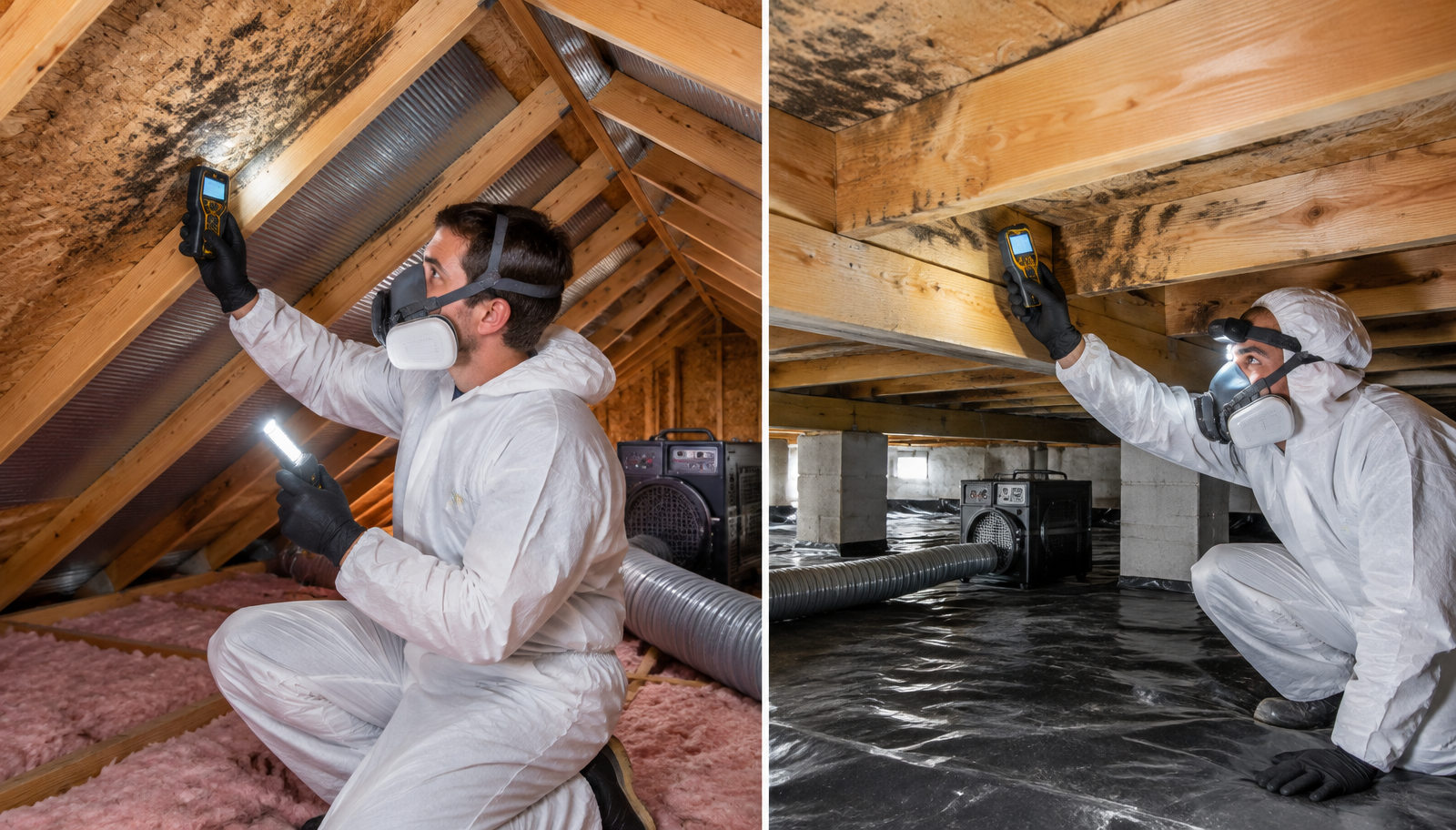
Attics and crawl spaces are two of the most common places for hidden mould to establish before it is visible inside the living area. Both sit at the edge of the building envelope, but they fail for different reasons: attic growth is usually driven by warm indoor air condensing on cold roof sheathing, while crawl-space growth is commonly driven by ground moisture, drainage, plumbing leaks, or humid outdoor air meeting cool framing.
If you smell a persistent earthy odour, see dark spotting on roof sheathing or floor joists, or an inspection has flagged possible growth, book a professional mould inspection or call (855) 324-7356. We inspect and treat attic and crawl-space mould across Ottawa, Nepean, Kanata, Barrhaven, Orléans, Carleton Place, Kingston, Brockville, Cornwall, Belleville, and Eastern Ontario.
Quick answer: what should happen first?
A competent inspection should answer four questions before treatment begins:
- Is the material actually mould, and how far does it extend?
- What moisture source allowed it to grow?
- Can the affected material be cleaned, or must porous material be removed?
- Is there a hazard—such as vermiculite insulation—that must be assessed before anyone disturbs the area?
Treating the staining without solving moisture is not remediation. The source, affected area, access conditions, insulation, ventilation, and occupant risks all belong in the written scope.
Why attic mould develops in Ottawa homes
During an Ottawa winter, indoor air carries moisture from showers, cooking, humidifiers, and normal occupancy. Air leakage at ceiling penetrations can carry that moisture into a cold attic, where it condenses on roof sheathing and fasteners. Repeated wetting supports mould growth even when the roof does not leak.
Common attic causes include:
- Bathroom, kitchen, or dryer exhaust terminating in the attic instead of outdoors
- Gaps around attic hatches, plumbing stacks, wiring, pot lights, and partition tops
- Blocked soffit vents or missing ventilation baffles
- Uneven or insufficient insulation that creates cold sheathing zones
- Roof leakage, ice dams, or wind-driven snow
- Indoor humidity that is too high for the outdoor temperature
Dark growth concentrated on the north-facing roof deck is common because that sheathing receives less solar warming. Location is evidence, but it is not a complete diagnosis; an inspector still needs to trace air leakage, ventilation, and bulk-water entry.
Why crawl-space mould develops
A crawl space can receive moisture from several directions at once. Bare soil releases water vapour. Foundation seepage and poor grading add bulk water. Plumbing leaks wet joists and subfloor. In warm weather, humid outdoor air can condense on cooler wood and mechanical surfaces.
Typical crawl-space warning conditions are:
- Exposed soil or a torn, incomplete ground vapour barrier
- Standing water, damp masonry, staining, or mineral deposits
- Wet insulation touching framing
- Plumbing, drain, or condensate leaks
- Musty air moving upward through floor openings
- Condensation on ducts, pipes, fasteners, or the underside of the subfloor
- Wood discolouration, fuzzy growth, or deterioration around the rim joist
A dehumidifier can help control humidity, but it cannot correct an active leak, groundwater entry, or missing moisture control. Equipment is part of a plan—not a substitute for diagnosis.
Signs that justify an inspection
Request an attic or crawl-space mould inspection when you notice:
- A musty odour with no visible source in the occupied rooms
- Black, grey, green, or white spotting on wood or insulation
- Frost or persistent condensation on attic nails and sheathing
- Water staining below bathroom fans or roof penetrations
- Peeling paint or ceiling stains beneath the attic
- Damp floors, cold-floor odours, or allergy symptoms strongest on the main level
- Growth identified in a home inspection or real-estate report
- A past roof, plumbing, sump, or drainage event that was never moisture-mapped
Health Canada advises addressing indoor mould regardless of colour or species and correcting the moisture source. It also notes that there is no health-based numeric exposure limit that can declare every building “safe” from one air sample. Read the federal guidance on addressing moisture and mould in your home.
What a professional inspection should include
1. Occupant and building history
The inspector records odours, seasonal patterns, roof or plumbing events, bathroom-fan locations, sump and drainage history, renovations, and any previous treatment. Seasonal timing matters: an attic that looks dry in September may show the moisture mechanism only during cold weather.
2. Safe visual assessment
The attic or crawl space is inspected from safe access points before anyone moves insulation. The assessment maps visible growth, staining, suspect insulation, ventilation paths, roof penetrations, plumbing, ductwork, exposed soil, and water entry.
3. Moisture mapping and thermal imaging
Moisture meters compare suspect wood and building materials with unaffected reference areas. Thermal imaging can locate temperature anomalies and possible moisture pathways, but it does not “see mould” and must be verified with direct readings.
4. Airflow and source investigation
The inspection checks whether exhaust ducts terminate outdoors, whether soffit-to-ridge ventilation is open, where indoor air is leaking into the attic, and whether crawl-space air is communicating with occupied rooms. For Ontario attics, ventilation design is assessed against the applicable building requirements—not by counting roof vents alone.
5. Sampling only when it answers a useful question
Visible growth with a clear moisture source often does not need species testing before remediation. Sampling can be useful when the source is uncertain, there is no visible growth, a sensitive occupant requires additional documentation, or a buyer, landlord, legal file, or independent clearance protocol calls for it. Any laboratory testing should have a defined purpose and an unaffected comparison where appropriate.
6. Written scope and priorities
The report should separate immediate remediation from moisture corrections by other trades. It should identify containment, affected materials, insulation handling, cleaning method, drying and verification, access limits, and any asbestos testing needed before disturbance.
Vermiculite and asbestos: do not disturb suspect attic insulation
Some older Canadian homes contain loose-fill vermiculite insulation. Government of Canada guidance explains that vermiculite sold before 1990—often associated with the Zonolite name—may contain amphibole asbestos. Risk increases when fibres are disturbed and become airborne.
Do not rake, vacuum, sample, or walk through suspect vermiculite to inspect mould. Stop the attic assessment, isolate access, and arrange appropriate testing before treatment. Our asbestos abatement service covers Ontario Type 1 and Type 2 requirements where an attic or crawl-space scope involves asbestos-containing material. Read the federal vermiculite insulation safety guidance.
How professional treatment differs by location
Attic mould treatment
A typical attic protocol may include controlled access, containment at the hatch and occupied areas, HEPA-filtered negative air, careful insulation handling, physical HEPA cleaning of affected wood, removal of non-salvageable porous material, and documented final inspection. The moisture cause must be corrected: duct termination, air sealing, roof leakage, insulation continuity, or ventilation work may require the appropriate licensed trade.
Crawl-space mould treatment
Crawl spaces require a plan for restricted access and cross-contamination. Treatment may include isolation from the living area, HEPA negative air, removal of contaminated insulation or debris, physical cleaning of joists and subfloor, structural drying, and verification. Ground vapour barriers, drainage, plumbing, insulation, or encapsulation corrections are coordinated with the proper contractor where they fall outside remediation.
Our work is mitigation and remediation only: inspection, containment, cleaning, controlled material removal, structural drying, hazardous-material abatement, sanitization, and documentation. We do not rebuild.
What not to do
- Do not spray bleach on attic sheathing or crawl-space framing. Surface colour may change while growth and moisture remain.
- Do not dry-brush, sand, or use a household vacuum; these actions can spread particles through the home.
- Do not paint or coat over growth before physical removal and moisture correction.
- Do not run a bathroom or dryer duct into the attic.
- Do not disturb vermiculite or unknown insulation.
- Do not rely on an air test alone to define the treatment area.
Verification: how you know the work is complete
Completion is based on evidence, not odour masking. A defensible closeout includes:
- The moisture source is corrected or assigned to the responsible trade
- Visible dust, debris, and growth are removed from the remediated area
- Materials meet the documented dry standard
- Containment and HEPA controls remained in place through cleaning
- Photos and moisture readings document conditions before, during, and after work
- Independent post-remediation verification or sampling is completed when the scope requires it
The IICRC S520 standard describes the professional framework for mould remediation, including preliminary determination, containment, structural remediation, and post-remediation evaluation.
Prevention for Eastern Ontario homes
For attics: vent exhaust fans outdoors; keep the attic hatch weather-stripped; air-seal ceiling penetrations; keep soffit paths open; correct roof leaks promptly; and use indoor humidity appropriate to winter conditions.
For crawl spaces: stop plumbing and drainage sources; keep the ground moisture barrier continuous and sealed; direct roof water away from the foundation; manage humidity based on whether the space is vented or conditioned; and inspect joists, rim areas, and insulation seasonally.
After any water event, fast water damage restoration and structural drying can prevent an inspection problem from becoming a large mould-remediation scope. For suspected growth in the capital region, see Ottawa mould remediation. For planning, use the free mould remediation cost estimator.
Direct-client documentation and insurance
Attic and crawl-space mould caused by long-term humidity or deferred maintenance is often treated differently from mould that follows a sudden covered water loss. Coverage depends on the cause and the wording of your policy.
We work directly for the client. Clients pay us for the inspection and remediation work, and we provide itemized documentation—photos, moisture readings, a written scope, and an Xactimate-format breakdown on request—that the client submits to their insurer for independent reimbursement. We do not administer the claim.
Where we inspect and treat attic and crawl-space mould
Our teams attend residential, commercial, rental, and real-estate inspection files across Ottawa, Nepean, Kanata, Barrhaven, Orléans, Gloucester, Manotick, Carleton Place, Kingston, Napanee, Gananoque, Brockville, Cornwall, Belleville, Trenton, and surrounding Eastern Ontario communities. View our service areas.
Suspect mould above or below your living space? Book a mould inspection, contact dispatch, or call (855) 324-7356.
Lire la version française : moisissure dans le vide sanitaire et l'entretoit.
Frequently asked questions
- What causes mould in an attic?
- The most common cause is warm, humid indoor air leaking through ceiling penetrations and condensing on cold roof sheathing. Bathroom or dryer ducts ending in the attic, blocked soffits, missing baffles, uneven insulation, roof leaks and ice dams can add moisture. Treatment must include finding and correcting that source.
- What causes mould in a crawl space?
- Common sources are exposed soil, a torn or missing ground vapour barrier, foundation seepage, poor drainage, plumbing leaks, wet insulation and humid air condensing on cool framing. A dehumidifier may control humidity but cannot replace source correction.
- How can I tell attic mould from frost or staining?
- Frost is crystalline and changes with temperature; mould or old water staining remains after the surface dries. Colour alone is not diagnostic. An inspection compares location and pattern with moisture readings, ventilation, air-leakage paths and roof conditions.
- Should I disturb vermiculite to inspect the attic?
- No. Some vermiculite installed in Canada before 1990 may contain amphibole asbestos. Do not rake, vacuum, sample or walk through it. Isolate access and arrange appropriate testing before any mould inspection or treatment disturbs the insulation.
- Do I need air testing before attic or crawl-space mould treatment?
- Not always. Visible growth with a clear moisture source can often be scoped without species testing. Sampling is useful when growth is hidden, the source is uncertain, a sensitive occupant needs additional documentation, or a transaction, legal file or independent clearance protocol requires it.
- How is attic and crawl-space mould treated professionally?
- The process is source investigation, controlled access, containment and HEPA negative air, removal of non-salvageable porous material, physical HEPA cleaning of salvageable structure, structural drying, detailed cleaning and documented post-remediation verification.
- Does insurance cover attic or crawl-space mould?
- Coverage depends on the cause and policy wording. Mould following a sudden covered water loss may be treated differently from chronic humidity, seepage or maintenance. Clients pay us directly and receive itemized documentation they submit to their insurer for independent reimbursement.
- Do you rebuild after mould treatment?
- No. Our scope is inspection, containment, controlled material removal, structural drying, hazardous-material abatement, sanitization and documentation. We return the area dry, decontaminated and verified for the client's own contractor to complete any repairs.
Service area — Ottawa
Professional attic and crawl-space mould inspection and remediation across Ottawa, the National Capital Region and Eastern Ontario.
- Primary city
- Ottawa, ON
- Dispatch
- 24/7/365 — (855) 324-7356
- Sectors covered
- NepeanKanataBarrhavenOrléansCarleton PlaceKingstonBrockvilleCornwallBelleville
Instant cost estimate
Preliminary CAD range in under a minute. A free on-site inspection confirms the scope, and financing is available while your claim is reviewed.
Estimated mitigation range
$3,978 – $5,850
Mitigation and remediation only — we do not quote or perform reconstruction.
Free instant cost estimators
Get a preliminary CAD range in under a minute — no obligation, no payment details. The on-site visual inspection that confirms it is free, and financing is available if paying up front is a concern.
About this guide & the team behind it
This article was written and reviewed by the PMII-certified restoration technicians at 24/7 Remedial Services, a Kingston, Ontario property-restoration company with more than two decades of combined field and construction experience across Eastern Ontario. We respond 24 hours a day, 7 days a week, 365 days a year to water, fire, smoke, mould, storm, and impact losses across Kingston, Napanee, Brockville, Gananoque, Picton, Belleville, Smiths Falls, Perth, Prescott, Carleton Place, and the surrounding Frontenac, Lennox & Addington, Leeds & Grenville, Lanark, Hastings, and Prince Edward county townships.
Every guide on this blog is grounded in the same industry standards Canadian insurance carriers expect on a properly documented claim file: the IICRC S500 standard for water damage restoration, the IICRC S520 mould standard for professional mould remediation, and industry-standard fire & smoke restoration practices for fire and smoke restoration. Where the article references a Category 1/2/3 water classification, a Class 1–4 drying environment, a Condition 1/2/3 indoor mould assessment, or a specific itemized line item, that terminology is used deliberately — it's the same vocabulary your adjuster uses and the same vocabulary that holds up in subrogation.
If you are dealing with an active loss as you read this, please do not wait. Most Kingston addresses see one of our restoration crews on-site within 60 minutes of dispatch — including overnight, on weekends, and during severe-weather events. Surrounding Eastern Ontario communities follow as quickly as travel allows. The cost of waiting on mitigation is almost always higher than the cost of acting immediately.
How our crews work
- › 24/7/365 dispatch from a Kingston base
- › Free written itemized insurance scope before any work begins
- › Daily timestamped moisture logs & photo documentation
- › Fully itemized documentation accepted by every major Canadian insurer
- › Emergency mitigation start to finish under one accountable project lead
What we restore
- › Water damage — burst pipes, floods, sewage backups
- › Fire & smoke — soot removal, deodourization, structural drying
- › Mould — IICRC S520 containment & clearance
- › Storm & impact — emergency board-up and tarping
- › Commercial, multi-unit, institutional & residential
Need restoration help right now?
24/7 Remedial Services dispatches PMII-certified crews around the clock across Kingston and Eastern Ontario. Whether the damage is water, fire, smoke, mould, or storm-related, calling early in the first 24 hours dramatically reduces the eventual scope of work, the disruption to your property, and the size of your insurance claim. Our team handles the mitigation and the documentation — so you only deal with one accountable contact from the first call through final verification, and you submit our itemized reporting to your insurer for your own reimbursement.